
Coprophagia means eating faeces. Is it a natural behaviour? Although we find it an extremely unpleasant behaviour, in many animals in the wild, it is actually pretty normal. Rodents, rabbits, beavers, elephants and non-human primates are all known to eat faeces, and it is thought to have nutritional value[2]. Dogs are scavengers, so it doesn’t seem to be a huge stretch to suggest that it is part of their normal repertoire of behaviours – although dogs are said to generally have an aversion to their own species’ faeces to avoid intestinal parasites[6]. Another factor may be the gender of the dog: female dogs are reported by one author to be almost twice as likely to be coprophagic than male dogs.[2] Perhaps there is a link to a bitches natural behaviour of cleaning away her puppy’s excrement? That said, a recent large survey found that gender or neuter categories, age, diet, ease of house training or association with a compulsive behaviour, bore no significant differences as to whether a dog would be coprophagic or not[6], so perhaps there’s no typical poop eater! A lot of dogs engage in this behaviour too – 16% sampled in a recent survey were said to be frequent eaters of dog poop (theirs, or other dogs’)[6], and an older study found that 49% weren’t as particular, having at some point partaken of the poop, dog or other animal![5]
That’s not to say we should just accept it and let them get on with it. It’s unhygienic to say the least, for your bearded pooch to gobble up poop and then give you a bit slobbery kiss. There are also parasitic risks, such as toxocariasis (roundworm), acquired by ingesting the parasite’s eggs found in fox, cat or dog faeces. If your dog has a penchant for horse poop, also be aware of the rare but possible risk of a dog ingesting toxic amounts of horse wormer[3]. Therefore, it is best to prevent coprophagia.
Causes: Medical
It is essential to rule out medical causes of coprophagia, so a visit to your vets should be your first port of call.
- Ensure your dog’s worming treatment is up to date. Ask your vet to check your dog’s stools for parasites. Even if this isn’t the initial cause of the problem, if your dog is regularly consuming other animals’ faeces, their chances of picking up parasites is increased.
- Consider if their diet is still suitable – ensure that your dog is on an appropriate diet for their age, breed, size, and lifestyle. If the coprophagia is a new phenomenon, but your dog’s diet hasn’t changed, check the labelling of the products: perhaps they have changed ingredients recently (“New Improved Formula”).
- Is your dog on medication for any other condition? Steroids, for example, may affect a dog’s digestive system and increase the likelihood of your dog seeking to increase their absorption of nutrients from other sources.
- Check the consistency of your dog’s stools. Loose stools, or those that show food has been poorly digested, are an indicator that something is not right in the digestive system. This could simply be down to their diet no longer suiting them. However, your vet can help you rule out other medical causes such as diabetes, Cushing’s disease, thyroid disease[1].
Causes: Behavioural
If your dog is healthy, and your vet is happy that it is not a medical issue, then you can consider it to be a behavioural problem. There may be little nutritional benefit at all, but for the behaviour to be repeated, it will have been reinforced somehow.
- A self-rewarding behaviour: the dog simply enjoys the taste/texture/smell of eating poop. Disgusting to us, but a delicacy to them!
- Perhaps you are inadvertently rewarding the behaviour: consider your reaction when the behaviour occurs. Do you spot the poop-eating, rush up to your dog singing “Nooooooo”, and then engage in a chase game where you are shooing your dog away? Think about that scenario from the dog’s perspective … “How can I get my human to play that fun chasing game with me? I know, I’ll eat the poo!”
- Has your dog learned the behaviour from another dog?
Behaviour Modification Plan
The suggestions below will help reduce coprophagia significantly. Don’t worry if you need help implementing it, a behavioural consultation can provide the support you need and personalise the plan for your dog.
Control & Management
These may seem like obvious suggestions, but control and management are going to be your most effective strategy.
- Avoid areas where you know the behaviour will occur.
- Use a long line to prevent poor recall away from faeces.
- Use a muzzle to prevent consumption. Many people prefer not to use a muzzle because they feel there is still a stigma attached to it. I’d urge you to overcome this worry – see The Muzzle Movement: Dog Muzzles That Look & Feel Good – a fabulous initiative and great products! Muzzles are becoming commonplace, and people are much more aware of the multiple reasons that dogs are seen with muzzles, such as recovering from surgery, dental issues and, of course, coprophagia. If it still bothers you, only put the muzzle on when you are in the “hot spots” where your dog frequently hunts for and consumes faeces. The health benefits outweigh what other people think, in any case.
- Encourage your dog to learn a “Hold it”, so that they can carry e.g., a ball or prey dummy, whilst you pass those poop hot spots. Giving a dog a job to do is often a very helpful strategy. You not only distract them, you get them to focus on you, they have an opportunity to earn a reward for a desired behaviour … and if their mouth is full they can’t pick up something unsavoury!
- Vigilance: there will be poops hidden away, under leaves and in long grass. You won’t always be able to spot it in advance. You should spend time observing your dog’s behaviour – do they have a really good sniff first, and then consume leisurely, savouring the moment? Do they get a whiff of it from a mile off, get very alert, and dash off and consume it speedily? Learning your dog’s cues will help you preempt the behaviour; you should be proactive and connect with your dog (e.g., ask them to walk to heel and reward them really well).
- For dogs that eat their own faeces (or other dogs in your household), the simplest answer is to clear it up immediately. There are products available, food additives, that purport to make poop eating undesirable by altering its taste – however, a survey in 2018 suggested that the efficacy was between 0 and 2% – so you may do well to save your money[6]!
Training Exercise: “Leave It”
If using a “Leave It” cue word was your only strategy, then you may find it isn’t all that effective. Only 4% of 424 people using this cue word found it successful[6] . So, simply hollering “Leave It” in your best ‘bouncer at a nightclub’ voice isn’t likely to do much good!
You need to train your dog to recognise the cue word, and for your dog to understand what it means. To your dog, the cue should mean “turn your head away from X because something better is available”. You need to begin with easy scenarios, where item X is not their most desirable object. Building a positive association with your “Leave It” will change your dog’s attitude – they should want to look away from X, because whatever you’re offering is more reinforcing. You might have the best food, something novel, smelly and interesting. Or you might be offering to play their favourite game. Your dog should begin to love hearing the cue “Leave It”. Think about what your dog currently understands when you say “Leave It”: do they see it as a sign to consume an item even more quickly because you’re coming along to tell them off? Do they see it as a sign that you’re about to engage in that peculiar chasing game “shoo them off of the poo”?! If so, consider changing your cue word.
You need to proof the lesson: practise it, gradually increasing the level of difficulty. Vary the objects your dogs should leave (distraction), get closer to the objects (distance), train increasing your distance away from your dog (distance), in a multitude of environments (distraction). It is better to increase the difficulty one step at a time – it gives you lots of opportunities to reward success. I’d suggest writing a list of your criteria – all of the scenarios on your training plan, how close you are to the dog, how far away from the item the dog is, what kind of environment (home, garden, playing fields, short grass, long grass, woodland area, etc.), and work one set at a time.
Make sure you don’t only use your “Leave It” for the emergency situation when they’re just about to chow down on unmentionables. You need to train it as an exercise in its own right, regularly and with plenty of well rewarded successes. Importantly, your ultimate goal is to be able to practice in increasingly close proximity to the offending articles – don’t rush to get to this stage, but it should be on your training plan. You may wish to use a long line / muzzle to ensure success. However, if you don’t practise in the real world, your dog won’t generalise the lesson. When your dog does successfully “Leave It” for real poo, reward them really really well!
Training Exercise: Recall
How good is your recall? If you are not certain that your dog will come back to you in a particular scenario, if you have just the slightest tingly feeling in your stomach that they might not come back, then DO NOT RISK IT FOR A BISCUIT! Be honest with yourself about your dog’s recall, not optimistic.
If your dog has the opportunity to ignore your recall and the result is fun – either playing with another dog, or eating faeces, then it is more likely to ignore your recall the next time. Their behaviour (running off) has been rewarded (by eating poop).
Using a Long Line training lead will help prevent failed recalls. Train the recall in a structured way, so you are constantly but very gradually increasing the level of difficulty. Begin in neutral environments with limited distractions, and the dog relatively near you. As you get successes under your belt, you can begin trying slightly more challenging environments or allowing the dog to venture further. Just as with your “Leave It”, your ultimate goal is to be able to practice in increasingly close proximity to the offending articles – you should be able to recall your dog away from a poop – but you need to put the foundations in.
Using a long line sometimes leaves people feeling a little flat – they worry that their dog isn’t going to enjoy their walk as much, or have as much freedom. Used properly, that isn’t the case at all, and I find that a walk can be more enjoyable because you connect so much more with your dog. I’d recommend “Line Training for Dogs” by Monika Gutmann, which has some super ideas for working your dog on a long line[7].
Conclusion
Coprophagia is a common problem amongst dog owners, but it is also a tricky behaviour to overcome. Your best option is prevention, which may be challenging on a walk. I recommend setting aside any reservations about using a long line or a muzzle; these training aids are invaluable resources. Alongside that, teaching a seriously good “Leave It” and Recall are paramount – your training should go back to the very basics, and from there build on plenty of well-rewarded successes in gradual steps until you are practising in the real world. Consistent training is going to be essential. Remember, don’t be a bouncer, and don’t expect to say “Leave It” and perform a Recall, and for it to work, if your dog hasn’t been trained to that level of difficulty.
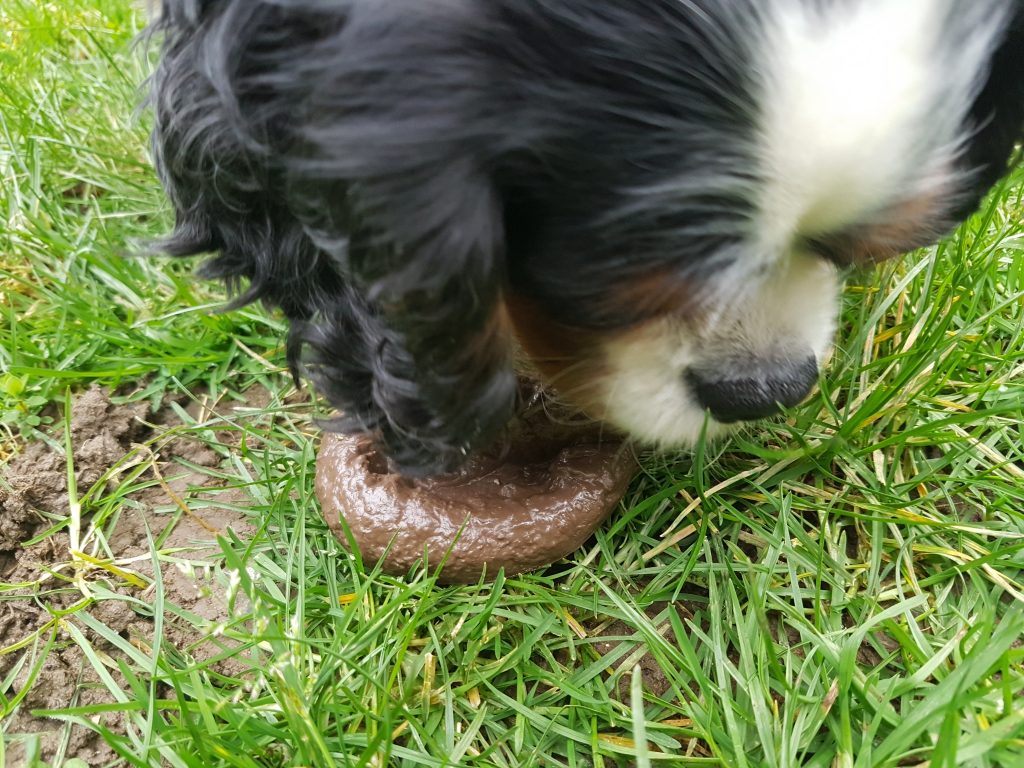
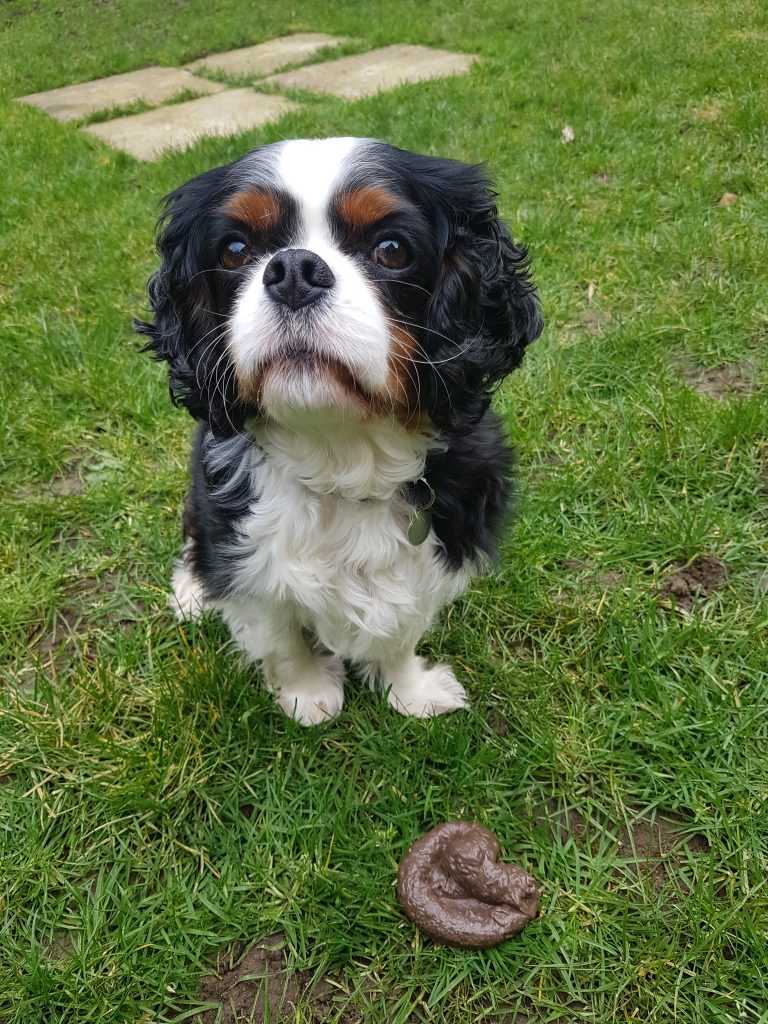
p.s., no real poop was consumed in the photos! The charming little Cavalier was investigating fake poops used in a training session!
References
- Boze B. (2008) A comparison of common treatments for coprophagy in Canis familiaris. Journal of Applied Companion Animal 2, 22–28. http://www.associationofanimalbehaviorprofessionals.com/vol2no1boze.pdf
- Hart, B. L., Hart, L.A., Thigpen, A. P., Tran, A. & Bain, M. J. (2018). The paradox of canine conspecific coprophagy. Veterinary Medicine and Science, DOI: 10.1002/vms3.92 https://onlinelibrary.wiley.com/doi/full/10.1002/vms3.92